Why PLG Users Don't Convert (And What Video Can Do About It)
You're acquiring users. They're signing up. Some even love your product. But they won't upgrade. Here's why the free tier feels "good enough" and how video closes the gap.
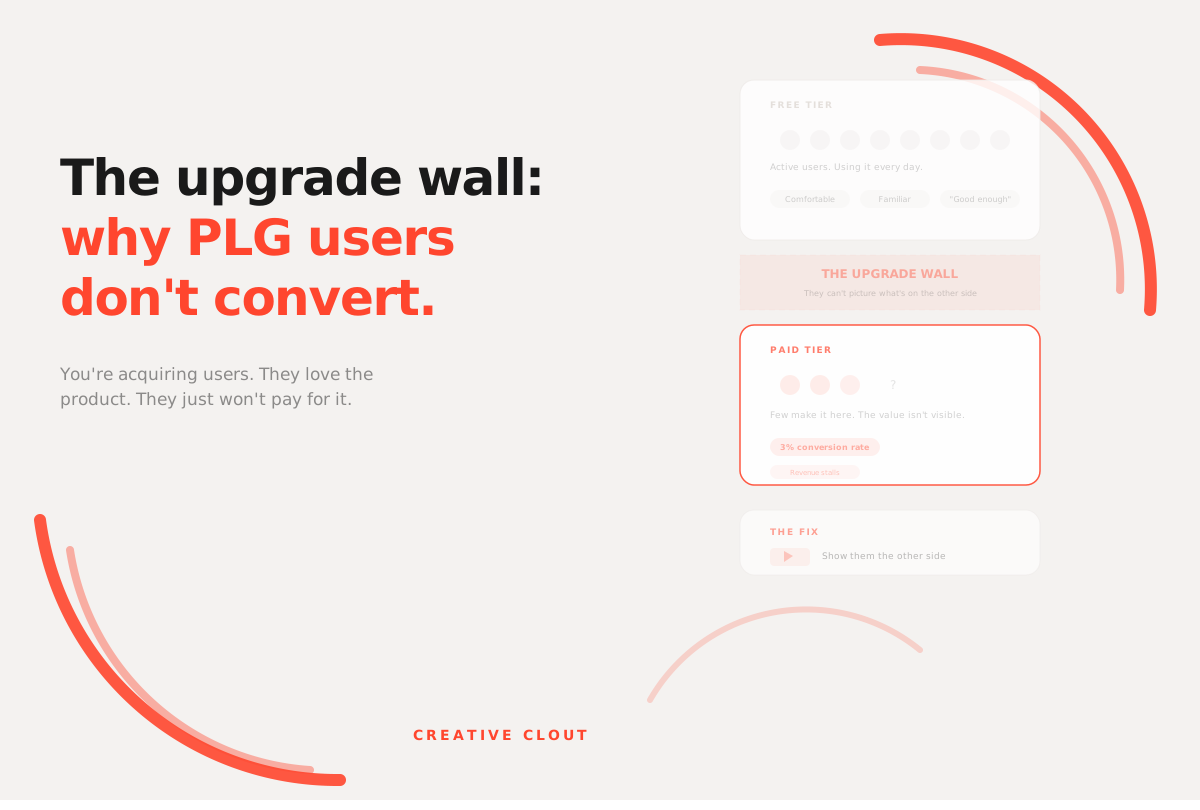
You're spending money on acquisition. Ads, content, SEO, partnerships. It's working. Users are signing up. Your sign-up graph is going up and to the right.
But your revenue graph isn't keeping pace.
The users are there. Some of them log in every day. Some of them have been on the free tier for months. They clearly find value in your product. And they won't pay for it.
This is the upgrade wall. It's the single most expensive failure point in product-led growth because every dollar you spent acquiring that user, every piece of content that brought them in, every ad that drove the click, all of that investment gets stranded at the moment of monetization. You didn't lose them. You just can't convert them.
Why "good enough" is your biggest competitor
The conventional thinking is that users don't upgrade because the paid tier isn't compelling enough. Add more features behind the paywall. Make the free tier more restrictive. Create urgency through limits.
Sometimes that's the issue. But more often, the problem isn't what's behind the paywall. It's that the user can't clearly see what's behind the paywall. They see a list of features they'd unlock. They see pricing tiers with checkmarks. They think "I'm getting by fine on free. Those extra features are nice but not worth $X a month."
The user isn't making a rational evaluation of value. They're making a gut decision based on what they can picture. And right now, all they can picture is what they already have. The free tier is familiar. It's comfortable. It works well enough. The paid tier is abstract. It's a list of capabilities they haven't experienced yet. Abstract always loses to familiar.
This is why feature comparison tables don't drive upgrades. They present information. They don't create desire. The user reads "Advanced analytics" and thinks "I probably don't need that." They read "Priority support" and think "I haven't needed support yet." Every line item on the comparison table gives the user a reason to talk themselves out of upgrading rather than into it.
The real gap is imagination
The reason users stay on free isn't that they don't want more value. It's that they can't imagine what more value feels like. They know what their daily workflow looks like with the free tier. They don't know what it looks like with the paid tier. And humans are terrible at imagining experiences they haven't had.
Think about the last time you upgraded a subscription on any product. What pushed you over? It probably wasn't a feature list. It was a moment where you hit a wall, felt the limitation viscerally, and could suddenly picture how much better things would be without that limitation. The upgrade happened because you felt the gap between where you were and where you could be.
Most PLG companies leave that moment to chance. They wait for the user to hit a limit organically, hope the frustration is strong enough to trigger an upgrade, and present a pricing page at the moment of friction. Sometimes it works. More often, the user finds a workaround, stays on free, and the moment passes.
The companies that convert at significantly higher rates don't leave that moment to chance. They create it.
How video closes the imagination gap
A video positioned at or near the upgrade moment does something a feature list can't: it shows the user what their experience looks like on the other side.
Not "here are the features you'd unlock." Instead: "here's what your Monday morning looks like on the paid plan. Here's how your reporting workflow changes. Here's what your team sees when they log in. Here's what becomes possible that isn't possible right now."
The user goes from abstract evaluation ("do I need advanced analytics?") to concrete visualization ("my whole team could see these dashboards instead of me pulling reports manually every week"). That shift from abstract to concrete is what triggers the upgrade decision. The user can suddenly picture the better version of their daily experience, and "good enough" stops feeling good enough.
This is the same psychological mechanism that drives the best SaaS homepage videos. The difference is context. A homepage video shows a cold visitor what their world could look like with your product. An upgrade video shows an active user what their world could look like with more of your product. Same principle. Different audience. Different stakes.
Where the upgrade video lives
The placement matters as much as the content. An upgrade video buried in your help docs won't get seen. An upgrade video that auto-plays when the user hits a feature limit feels intrusive. The placement needs to feel natural, timely, and helpful rather than pushy.
The most effective placements are on the pricing page itself, near the comparison table but above it. The user who navigates to your pricing page is already considering an upgrade. They're in evaluation mode. A 45 to 60 second video that shows the transformation before they scroll down to the feature grid reframes the entire decision from "which features do I get" to "what does my experience become."
In the upgrade prompt or paywall modal. When a user hits a feature limit, they see a message that says "this feature is available on the paid plan." Most companies put a button and a feature list here. Adding a short video that shows what this specific feature unlocks in context turns a moment of frustration into a moment of aspiration.
In an email sequence triggered by usage milestones. When a user has been active on the free tier for 14 or 30 days, they've demonstrated that they find value in the product. An email with a video that says "you've been using [Product] for two weeks, here's what unlocks when you upgrade" hits at the perfect moment because the user has context. They know what the free tier feels like. Now they can see what more feels like.
In the product itself as a subtle touchpoint. A small video icon or "see what's possible" link near locked features that opens a quick 20 to 30 second clip showing that specific capability in action. Not a gate. Not a hard sell. An invitation to see more.
What the upgrade video should not do
It should not list features. The user can read the feature comparison table on their own. The video's job is to create desire, not deliver information.
It should not make the user feel bad about being on free. Messaging like "you're missing out" or "stop limiting yourself" creates resentment, not motivation. The framing should be aspirational: "here's what becomes possible" rather than "here's what you're losing."
It should not be your homepage explainer repurposed. Your homepage video targets someone who doesn't know your product. Your upgrade video targets someone who uses it daily. They don't need an introduction. They need to see the next level. Showing them the basics they already know wastes their time and signals that you don't understand where they are in the journey.
It should not be longer than 60 seconds. The user is making a binary decision: upgrade or don't. A long video introduces new reasons to hesitate. Keep it tight. Show the transformation. End with the upgrade action.
The math that makes this obvious
Take a PLG company with 10,000 active free users and a 3% free-to-paid conversion rate. That's 300 paying customers.
If an upgrade video at the paywall moves the conversion rate from 3% to 4.5%, that's 450 paying customers. 150 additional conversions from the same user base. No additional acquisition spend. No product changes. No pricing restructure.
At $50 per month per user, that's $7,500 in additional monthly recurring revenue from a single video. At $100 per month, it's $15,000. The video pays for itself in the first month and keeps producing returns every month after.
This is why the upgrade wall is the highest-leverage video opportunity in PLG. You've already done the expensive work of acquiring and activating users. The video just closes the last mile.
The retention layer
There's a second benefit that gets overlooked. Users who upgrade after watching a video that shows them the full value of the paid tier churn at lower rates than users who upgrade impulsively or out of frustration.
When someone upgrades because they saw a feature limit and clicked "upgrade" out of annoyance, they haven't internalized the full value of what they're paying for. They solve their immediate friction and then forget what else the paid tier offers. When renewal time comes or when budget gets tight, they can't articulate why they're paying.
When someone upgrades because a video showed them the complete transformation of their experience, they enter the paid tier with clear expectations. They know what they're paying for. They know what to explore. They're more likely to adopt the full feature set, more likely to see ongoing value, and more likely to stay past the first 90 days.
The upgrade video isn't just a conversion tool. It's a retention tool. It sets expectations that lead to satisfaction rather than letting users discover value randomly and hope for the best.
How to tell if you have an upgrade wall problem
Look at three things.
What's your free-to-paid conversion rate? If it's below 5%, your free users aren't seeing enough reason to pay. The value of the paid tier isn't landing clearly enough.
How long do users stay on free before upgrading? If the average is over 30 days, users are finding the free tier sufficient for too long. Something needs to accelerate their realization of what they're missing.
What does your pricing page look like? If it's a feature comparison grid with no narrative, no video, and no transformation framing, you're asking users to evaluate a list rather than feel a difference. That's a conversion tool problem, not a product problem.
You've already acquired these users. You've already proven the product works. The only thing between your current revenue and significantly more revenue is whether your users can clearly see what's on the other side of the upgrade. Show them.