How to Write a SaaS Explainer Video Script That Actually Converts
Most SaaS video scripts are feature tours disguised as stories. Here's how to write a script that starts with the buyer's reality, creates urgency, and makes people act.
The script is the most important part of any SaaS explainer video. Not the animation. Not the voiceover. Not the music. If the script doesn't land, nothing else matters. A beautifully animated video with a weak script is an expensive decoration. A simply animated video with a sharp script is a sales tool.
Most SaaS companies either write their own script and hand it to an agency to animate, or they let the agency write it based on a creative brief. Both approaches produce the same result more often than not: a feature tour with nice visuals. The product's capabilities get explained clearly. The viewer understands what the product does. And then they close the tab because understanding isn't the same as wanting.
Here's how to write a script that actually makes people act.
Start with the buyer's world, not your product
The first 10 seconds of your video determine whether someone keeps watching or scrolls past. Most SaaS scripts open with the company name, the product category, or a feature. "Meet DataSync, the all-in-one analytics platform." "With our AI-powered engine, teams can..." "Introducing the future of project management."
Every one of those openings asks the viewer to care about something they have no reason to care about yet. You're leading with yourself. The viewer is thinking about themselves.
Flip it. Open with something the viewer recognizes from their own experience. A frustration. A scenario. A moment they've lived through this week.
"Your team spends Monday morning in a meeting just getting aligned on what happened last week."
"Every new prospect asks the same three questions before they even understand what you do."
"You've got data in four different tools and nobody trusts the numbers in any of them."
The viewer hears their own life described back to them. They stop scrolling. They lean in. Trust starts building immediately because they feel understood before you've said a single word about your product.
This isn't just a better creative choice. It's a structural decision that changes the entire trajectory of the video. When you start with the buyer, everything that follows is framed as a response to their problem. When you start with the product, everything that follows is a pitch they have to evaluate skeptically.
Build stakes before you introduce the solution
After the opening, most scripts immediately pivot to the product. "That's why we built [Product]." The problem gets 10 seconds. The solution gets 50 seconds. The ratio is backwards.
The viewer needs to feel the weight of the problem before they're ready to hear about a solution. Not just understand it intellectually. Feel it. What is the cost of this problem continuing? What happens if they don't fix it? What are they losing every week, every month, every quarter?
"That Monday meeting isn't just annoying. It's costing your team five hours a week in alignment time. That's 260 hours a year spent talking about what happened instead of deciding what to do next."
"Those three prospect calls where you're re-explaining the basics? Each one is 15 minutes your AE could be spending on deals that are ready to close."
When the viewer feels the cost of inaction, the product becomes relief. You don't have to convince them your features are good. They're already looking for something to make the pain stop. Your product arrives as the answer to a problem they now feel urgently, not as an option they're casually evaluating.
The rule of thumb: spend at least 30% of your script on the problem and its stakes. Most SaaS scripts spend 10% or less.
Show transformation, not features
When you do introduce your product, resist the urge to walk through features. "Our platform offers real-time dashboards, automated reporting, seamless integrations, and AI-powered insights" is a list. Lists don't create desire. They create evaluation.
Instead, show the buyer's world after they have your product. The transformation. The before and after. What their Monday morning looks like now. What happens when a prospect visits their website. How their team operates differently.
"Instead of that Monday alignment meeting, your team opens a single dashboard. Everyone sees the same numbers. The meeting is five minutes instead of fifty. They spend the rest of the morning actually working."
This approach works because it lets the viewer project themselves into the after state. They're not evaluating features abstractly. They're picturing their own life improving. That's a fundamentally different psychological response, and it's the one that makes people take action.
Features can still appear in the script. They just shouldn't be the headline. They're supporting evidence for the transformation, not the story itself. "Real-time dashboards" is a feature. "Your whole team sees the same numbers, updated live" is a transformation that happens to involve a feature.
Handle objections before they form
Every SaaS product has recurring hesitations. Your sales team hears them on every call. "Is it hard to implement?" "Will my team actually adopt it?" "How is this different from what we use now?" "We tried something similar and it didn't work."
Most video scripts ignore these entirely. They present the positive case and hope the viewer doesn't think about the downsides. But the viewer always thinks about the downsides. If you don't address them, those unspoken objections sit in the background and quietly erode the conviction your script is trying to build.
The fix isn't a section of the video called "common objections." That feels defensive and salesy. The fix is weaving objection handling into the narrative naturally.
If the biggest objection is implementation difficulty, include a brief moment that shows the timeline. "Day one: connect your existing tools. Week one: your team is onboarded. Week two: you're running your first reports." The objection dissolves because the viewer saw the answer without ever having to ask the question.
If the biggest objection is "we tried this before," address it through contrast. "Most tools in this space take the data you give them and put it on a dashboard. We do something different." Then show the difference. The viewer thinks "oh, this isn't like the thing that failed." Without you ever saying "we're not like the others."
To identify which objections to handle, talk to your sales team. Ask them: what are the three questions or hesitations you hear most often? Those become mandatory elements in your script, woven into the narrative rather than tacked on at the end.
Write for the ear, not the eye
A video script is not a blog post. It's not a landing page. It's spoken word set to visuals. That means the writing rules are different.
Short sentences. A viewer can't re-read a sentence in a video the way they can on a webpage. If a sentence takes more than one breath to say, break it in two.
Conversational tone. Write the way you'd explain your product to someone at a dinner party. Not formal. Not salesy. Direct and natural. Read it out loud. If it sounds like marketing copy, rewrite it until it sounds like a person talking.
One idea per sentence. Don't stack multiple concepts into a single line. "Our platform integrates with your existing tools, automates your reporting workflows, and provides AI-powered insights that help your team make better decisions faster." That's three ideas competing for attention. The viewer retains none of them. Break it up. Give each idea room to land.
Pace variation. Some lines should be fast and punchy. Some should slow down and breathe. If every line has the same rhythm, the viewer zones out. Vary the length and cadence. Short line. Then a longer line that builds on the idea and gives it room to develop. Then another short one.
Write pause points. Not every second needs words. A moment of visual storytelling with no voiceover lets the viewer process what they just heard. The best scripts build in 3 to 5 seconds of breathing room at key transition points.
Structure that works
After writing hundreds of SaaS video scripts, here's the structure that consistently converts.
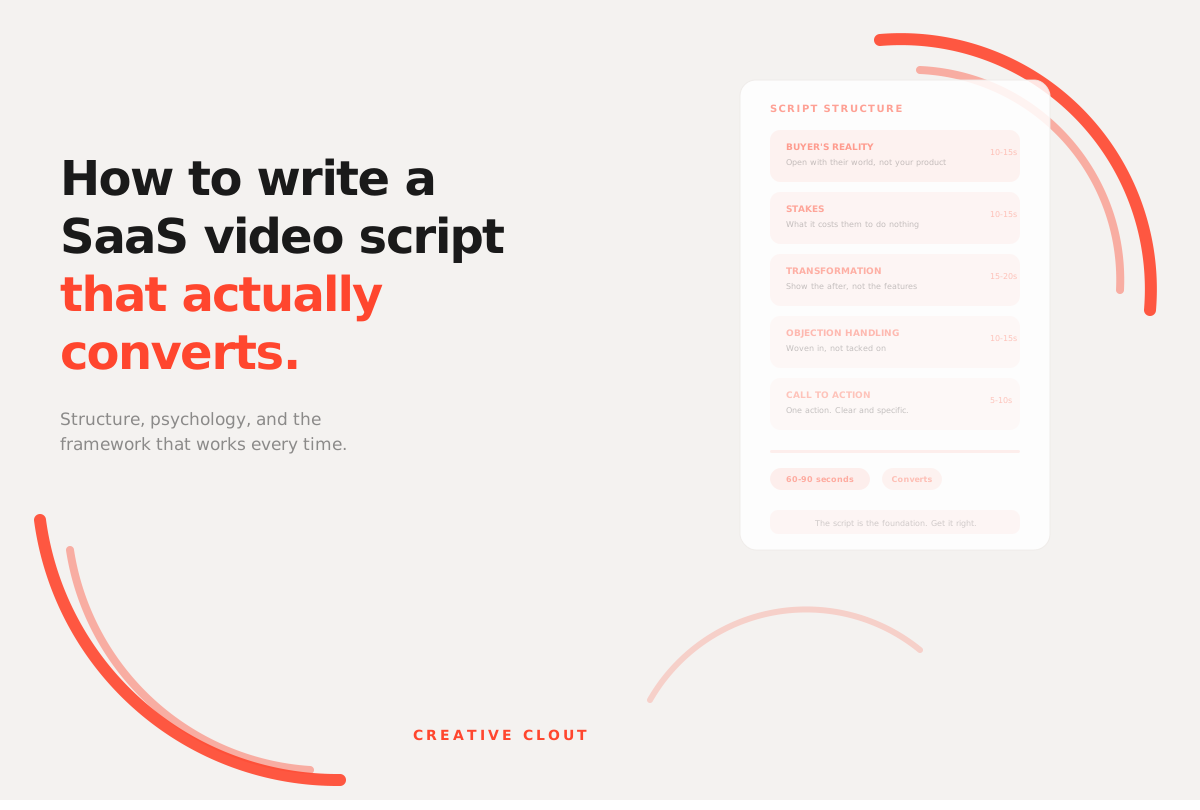
Open with the buyer's reality. 10 to 15 seconds. One scenario they recognize. Make them feel seen.
Build the stakes. 10 to 15 seconds. What does this problem cost them? What gets worse if they don't fix it? Make the status quo feel unacceptable.
Introduce the transformation. 15 to 20 seconds. Show the after state. What their world looks like with your product. Frame it around their workflow, not your features.
Handle one or two objections. 10 to 15 seconds. Woven into the narrative. Implementation, adoption, differentiation. Whatever your sales team hears most.
Call to action. 5 to 10 seconds. Clear, specific, low friction. "Book a call" or "start your free trial." One action. Not three.
That's 50 to 75 seconds of script. A 60 to 90 second video at a natural speaking pace. Tight enough to hold attention. Long enough to build conviction.
The test before you produce
Before you send your script to animation, run it through three checks.
Read it out loud to someone who knows nothing about your product. After hearing it once, can they tell you what the product does and why it matters? If they can describe the transformation but not list the features, you've written a good script. If they can list features but not explain why they matter, rewrite.
Count the seconds spent on the problem versus the product. If your product appears in the first 10 seconds, the script is product-centered. If the viewer doesn't hear your product name until at least 15 seconds in, the script is buyer-centered.
Identify the one feeling the viewer should have at the end. Not "informed." Not "educated." Those are passive. The feeling should be active: "I need to fix this" or "I want that" or "I should talk to these people." If the script doesn't create an active feeling, the stakes aren't high enough or the transformation isn't vivid enough.
The script is the foundation everything else is built on. Get it right, and even modest animation will produce a video that converts. Get it wrong, and no amount of production value will save it.