SaaS Explainer Video Pricing: What to Expect in 2026
SaaS explainer videos range from $2,000 to $25,000+. Here's what drives the price, what you should actually pay, and how to avoid wasting money on a video that looks great but does nothing.
If you've started researching explainer video pricing for your SaaS company, you've probably noticed the range is absurdly wide. You can find agencies quoting $1,500. You can find agencies quoting $25,000. Both claim to produce "high-quality SaaS explainer videos." Both have portfolios that look decent. And neither makes it easy to understand what you're actually paying for.
Here's what the market actually looks like in 2026, what drives the price up or down, and how to make sure you're spending money on a video that moves your business forward rather than one that just looks good on your homepage.
The real pricing landscape
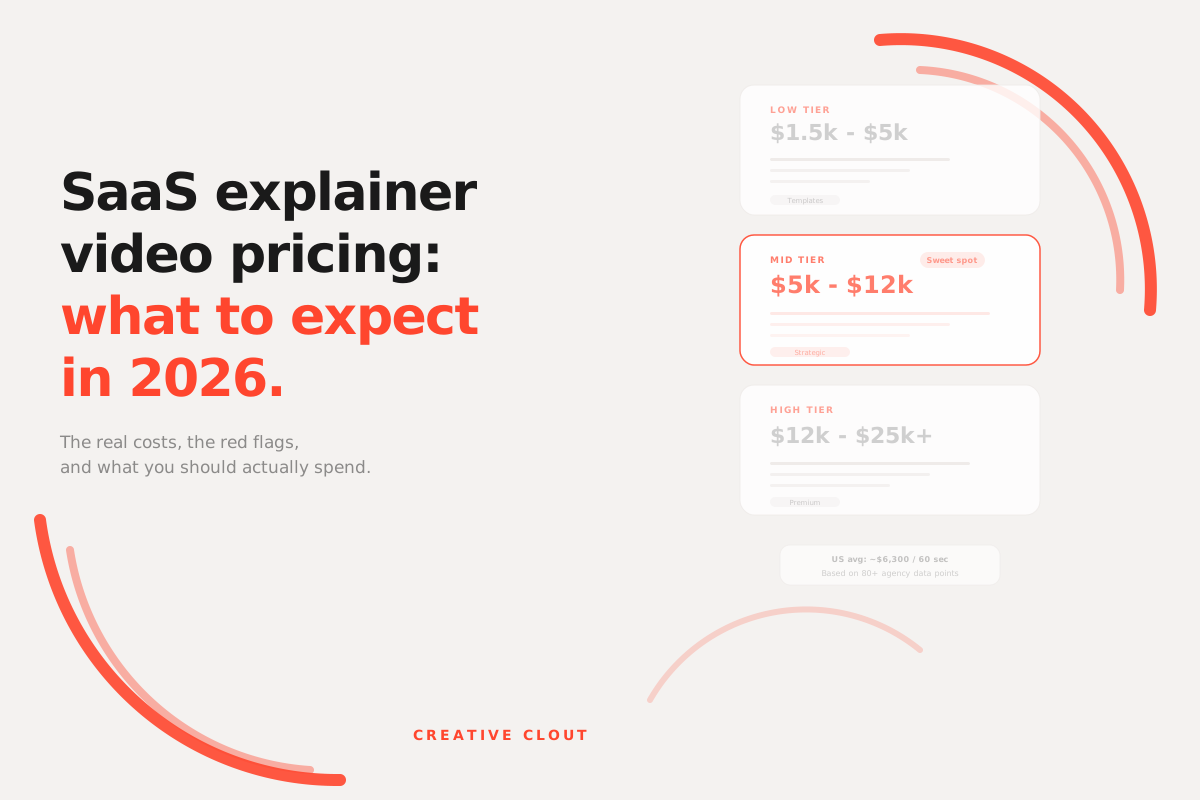
Based on market data across 80+ agencies and hundreds of data points, here's where SaaS explainer video pricing actually falls in 2026.
The low tier runs $1,500 to $5,000. At this level, you're typically getting template-based work, junior animators, or offshore production. The animation will be clean enough, but the scripting is usually surface-level. You provide the brief, they animate what you give them. Strategic input is minimal. This tier works for internal training videos or quick social content where the stakes are low. It's risky for anything customer-facing that needs to convert.
The mid tier sits at $5,000 to $12,000. This is where most funded SaaS companies land. At this price point, you should be getting custom design, strategic scripting, professional voiceover, and a team that understands how SaaS buyers think. The agency takes ownership of the narrative, not just the animation. This is the sweet spot where quality, customization, and value are well balanced. US-based companies specifically spend an average of around $6,300 for a 60-second video, though that number climbs when strategic scripting and narrative development are included.
The high tier is $12,000 to $25,000+. This is premium boutique territory. You're paying for deep strategic involvement, potentially a full messaging audit, multiple rounds of revision, and production quality that competes with the best work in the market. Agencies like Explainify, Demo Duck, and Yum Yum Videos operate in this range. The quality difference between a $7,000 video and a $20,000 video is often minimal in terms of visual output. What you're paying for at the top is the depth of strategic thinking and the comprehensiveness of the engagement.
What actually drives the price
Video length is the most obvious factor, but it's not the most important one. A 90-second video costs more than a 30-second video because there's more animation work. But the real price drivers are less visible.
Animation style matters significantly. Simple motion graphics with text and icons cost less than custom character animation. Custom character animation costs less than 3D. Isometric animation falls somewhere in between. Most SaaS companies get the best results from clean motion graphics and UI animation because that style matches how their buyers already think about software products.
Scripting depth is where the real value difference lives. An agency that takes your brief and turns it into a script is doing fundamentally different work than an agency that conducts a discovery session, diagnoses your messaging gaps, and builds a narrative from scratch. The second approach takes more time, requires more expertise, and produces a script that's strategically aligned with how your buyer makes decisions. That process is what separates a video that explains your product from one that actually sells it.
Voiceover quality affects pricing. AI-generated voiceover is essentially free. A professional voiceover artist costs $300 to $1,500 depending on their experience and usage rights. The difference in perceived quality and trust is significant for customer-facing content.
Revision rounds can inflate costs if not structured properly. Most agencies include two to three rounds at each stage. Additional rounds typically cost extra. The agencies with the lowest revision costs tend to be the ones that invest the most in upfront discovery, because when the strategic direction is right from the beginning, fewer revisions are needed.
Red flags in cheap quotes
If an agency quotes you under $3,000 for a custom SaaS explainer video, be cautious. Here's what to watch for.
Template-based production. The characters, backgrounds, and transitions in your video might show up in another company's video next month. For a SaaS product that needs to stand out in a crowded market, this is a real problem. Your video should feel like it was built for your brand, not pulled from a library.
No strategic input on the script. If the agency asks you to "fill out a brief" and then animates what you wrote, you're paying for production, not strategy. The script is the most important element of any explainer video. If nobody is challenging your assumptions about what your buyer needs to hear, the video will describe your product accurately without actually persuading anyone.
Unrealistic timelines. A quality 60-second SaaS explainer takes 3 to 6 weeks when done well. If someone promises it in 5 days, the corners being cut are usually in the script and the storyboard, which is where most of the strategic value lives.
No discovery process. If the agency doesn't spend time understanding your product, your buyer, and your sales process before they start creating, the video will be generic. It might look professional, but it won't be specific enough to your situation to make a difference.
Red flags in expensive quotes
Paying more doesn't automatically mean getting more. Here's what to watch for at the high end.
Paying for brand prestige rather than output quality. Some agencies charge premium rates because they can, not because the work justifies it. The visual quality difference between a $7,000 video and a $15,000 video is often hard to spot. What should justify the premium is deeper strategic work, more comprehensive deliverables, or a proven track record of producing videos that drive measurable results.
Hidden fees for basics. Some agencies quote a base price and then add charges for voiceover, sound design, music licensing, source files, or additional aspect ratios. Make sure you understand what's included before you sign. A $10,000 quote that includes everything might be a better deal than a $7,000 quote with $4,000 in add-ons.
Long timelines without clear justification. If an agency quotes 8 to 10 weeks for a 60-second video, ask why. Some of that time might be genuine (complex animation, multiple stakeholders, thorough review cycles). Some of it might be inefficiency or resource scheduling that has nothing to do with your project.
How to think about pricing instead of duration
The most common mistake SaaS companies make when buying video is thinking in terms of price per second. "How much for a 60-second video?" turns the conversation into a commodity comparison where the cheapest option wins.
A better approach is to think about what outcome you need and what scope of work produces that outcome. A 60-second explainer that lives on your homepage and pre-sells prospects before sales calls is a different product than a 60-second feature walkthrough for social media. They might be the same length, but the strategic depth, scripting complexity, and business impact are completely different.
Some agencies have caught onto this and now package their offerings around outcomes rather than duration. Instead of "30 seconds for $X, 60 seconds for $Y," they offer tiers based on what you get strategically: a core explainer, an explainer plus ad cut-downs, or a full video system with multiple assets and distribution guidance. This framing makes it easier to evaluate what you're actually buying and harder to compare on price alone.
What you should actually spend
For most funded SaaS companies that need a video to live on their homepage, support their sales process, and build trust with prospects, the right investment is in the $5,000 to $10,000 range. At this level, you should expect custom design, strategic scripting, professional production, and a team that understands your market.
If you need multiple assets (an explainer plus ad cut-downs plus a spotlight video for launches), budget $10,000 to $15,000 for a full package. The per-asset cost drops significantly when produced together because the strategic and design foundation is built once and extended across all deliverables.
If your budget is under $5,000, be realistic about what you'll get. You can still produce a useful video, but the strategic depth will be limited. Consider starting with a shorter spotlight video and expanding later as budget allows.
The most important thing to remember: the cost of a video that doesn't work is higher than the cost of a video that does. An $8,000 video that shortens your sales cycle by two weeks pays for itself on the first deal it influences. A $3,000 video that looks nice but changes nothing is $3,000 wasted.
Questions to ask any agency before you hire them
What does your discovery process look like? If they don't have one, they're skipping the most important step.
Who writes the script? If it's you, you're paying for animation, not strategy.
What's included in the price? Get a clear answer on voiceover, sound design, revisions, source files, and aspect ratios.
Can you show me a video you made that actually moved a business metric? Not just "the client loved it." Did it change pipeline, conversion, or sales efficiency?
How do you handle revisions? Two rounds at each stage (script, storyboard, final) is standard. Anything less is restrictive. Anything unlimited sounds generous but might mean they expect more back-and-forth because the upfront process is weak.
What does your timeline look like? 3 to 6 weeks for a 60-second video is standard. Faster is possible but should come with a clear explanation of how quality is maintained.
Your video is an investment in how your market perceives and understands your product. The right partner doesn't just produce something that looks good. They produce something that works.