What Makes a Great SaaS Product Video
Most SaaS videos look professional but don't change anything. Here's what separates a video that gets compliments from one that actually shortens sales cycles and converts buyers.
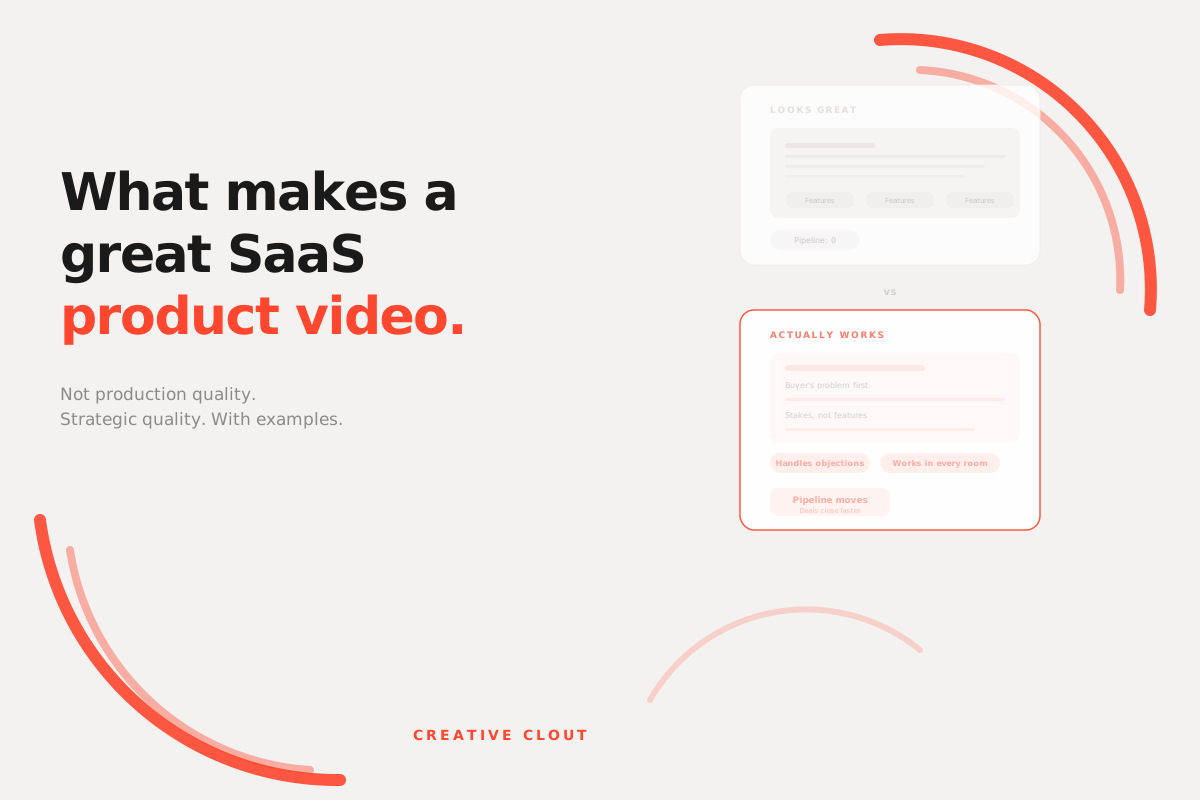
There are thousands of SaaS explainer videos on the internet. Most of them are fine. Clean animation, professional voiceover, clear explanation of what the product does. They check every box. And they don't move the needle.
The videos that actually drive results for SaaS companies look different. Not necessarily in production quality. Sometimes the animation is simpler. Sometimes the runtime is shorter. The difference is in how the story is constructed, what the viewer feels by the end, and whether the video changes behavior or just creates a moment of "that was nice."
Here's what separates the two.
It starts with the buyer, not the product
The single biggest difference between a SaaS video that works and one that doesn't is the opening 10 seconds. Most videos open with the product. "Meet [Product Name], the all-in-one platform for [category]." Or they open with a feature. "With our AI-powered analytics engine, you can..."
The viewer processes this analytically. They're evaluating a claim. They're skeptical. They're one thumb-scroll away from leaving.
Videos that work open with the buyer's reality. Not the product. Not the company. The viewer's own experience. "Your team spends the first half of every meeting just getting aligned on what happened last week." "You've got data in six different tools and no single source of truth." "Every new prospect asks the same three questions before they even understand what you do."
The viewer hears their own problem described back to them. They stop scrolling. They lean in. They think "okay, this company gets it." Trust begins before you've said a single word about your product.
This isn't a minor stylistic choice. It's the structural decision that determines whether your video creates passive understanding or active desire. When you start with the product, the viewer learns about you. When you start with the buyer, the viewer feels understood by you. One creates information. The other creates motivation.
It shows stakes, not features
After the opening, most SaaS videos walk through features. "Our platform offers real-time dashboards, automated reporting, seamless integrations, and customizable workflows." Each feature gets a few seconds of animation. The viewer nods along. By the end, they understand what the product does. They just don't feel any urgency to act.
The videos that drive action show the viewer what's at stake. Not what the product does, but what happens to their business without it. The cost of the status quo. The hours wasted. The deals lost. The decisions made on bad data. The competitor who figured this out six months ago and is now pulling ahead.
When a viewer feels the cost of inaction, the product becomes the relief. They don't need to be convinced that your features are good. They need to feel that their current situation is unacceptable. The product becomes the obvious solution to a problem they now feel urgently.
This is the difference between a video that "explains" and a video that "sells." Explanation creates understanding. Stakes create desire. You need both, but stakes need to come first.
It handles objections the viewer hasn't voiced yet
Every SaaS product has three to five recurring hesitations that slow down or kill deals. "Is it hard to implement?" "Will my team actually adopt this?" "We tried something similar before and it didn't work." "How is this different from [competitor]?"
Most videos ignore these entirely. They focus on the positive case and hope the viewer doesn't think about the downsides. But the viewer always thinks about the downsides. If the video doesn't address them, the objections sit in the back of the viewer's mind and grow into reasons not to act.
The best SaaS videos handle objections proactively. Not by saying "don't worry, implementation is easy." By showing what implementation actually looks like. A quick visual of a timeline. "Day one: we connect to your existing tools. Week one: your team is onboarded. Week two: you're running your first reports." The objection dissolves because the viewer saw the answer before they fully formed the question.
This is what separates videos made by people who understand sales from videos made by people who understand animation. An animator creates beautiful visuals. A strategist identifies the three things that stop someone from buying and addresses each one in the video before the viewer ever gets on a call.
It works when you're not in the room
A lot of SaaS videos are designed for one context: the homepage. Someone visits, watches, and either books a demo or leaves. That's a valid use case. But the best SaaS videos are designed to work across the entire sales process.
Your champion needs to pitch the product to their VP. Can they send your video and have it make the case effectively? Or does it only work as a first introduction?
Your sales rep is following up with a prospect who went dark. Can they include the video in an email and have it re-engage the prospect? Or is it too long, too general, or too "top of funnel" to be useful at that stage?
A marketing team is running paid ads. Can clips from your video be cut into 15 to 30 second pieces that work as standalone ads? Or is the narrative so linear that any excerpt feels incomplete?
The videos that generate the most value for SaaS companies are the ones designed with multiple contexts in mind from the beginning. The scripting considers how the story works in full and in fragments. The pacing allows for natural cut points. The narrative doesn't depend on the viewer watching from second one to the end.
This doesn't mean every video needs to be a Swiss army knife. It means the best videos are built with an awareness that they'll be used by salespeople, shared by champions, cut into ads, and embedded in emails. A video that only works on your homepage is doing one job. A video that works across your entire funnel is doing five.
The production quality threshold
Production quality matters, but not in the way most people think. You don't need cinematic 3D animation. You don't need a celebrity voiceover. You don't need a $25,000 budget. What you need is a production quality threshold that says "this company is professional and trustworthy."
Clean motion graphics with thoughtful design, professional voiceover with a natural tone, intentional sound design, and animation that matches your brand's visual language. That's the threshold. Anything above it is diminishing returns on trust. Anything below it actively undermines your credibility.
The companies that overspend on production and underspend on scripting end up with beautiful videos that don't convert. The companies that invest appropriately in both end up with videos that look professional enough to build trust and are scripted strategically enough to change behavior.
If you had to choose between a $15,000 budget spent 80% on animation and 20% on scripting, or a $8,000 budget split 50/50, the second option will outperform the first almost every time.
What to look for when evaluating a SaaS video
Whether you're reviewing your own video or evaluating an agency's portfolio, ask these questions.
Does the video open with the buyer's reality or the product's features? If you hear the product name in the first five seconds, the scripting is product-centered, not buyer-centered.
Does the viewer feel the cost of inaction? After watching, does the viewer think "that product is interesting" or do they think "I need to fix this problem"? The first is understanding. The second is motivation.
Are objections addressed or ignored? If the video is entirely positive with no acknowledgment of common hesitations, it's leaving the hardest questions for your sales team to handle live.
Would this work if forwarded to a stakeholder who's never heard of you? If the video only makes sense as a first introduction, it's serving one moment in the deal. If it makes the case clearly to someone who's being asked to approve a purchase, it's serving the moment that actually closes deals.
Does the production feel trustworthy without being excessive? The video should look and sound like a company you'd want to do business with. It shouldn't look like a company that spent their entire marketing budget on one video.
The SaaS companies that get the most from video are the ones that treat it as a strategic asset, not a creative project. The animation matters. The voiceover matters. But what matters most is whether the video changes how your buyer thinks, feels, and acts. Everything else is decoration.